Catch every crash Fix it with your own agent.
One wrapper captures every crash in your React or Next.js app with a session replay, console logs, network requests, breadcrumbs and a screenshot. BugBash explains it in plain English and writes a fix prompt for the coding agent you already use.
From a white screen to a test that keeps the bug dead.
Follow one sample crash through BugBash: a checkout that breaks when the shopper clicks Pay now.
One wrapper records the whole crash.
Wrap your app once in <BugBash>. When something breaks, the crash lands in your inbox with everything that happened just before it.
'use client'

import { BugBash } from '@bugbash/sdk'

export function Providers({ children }) {
  return (
    <BugBash      projectKey="demo-project"      environment="production"      sessionReplay      maskAllInputs    >      {children}
    </BugBash>  )
}
Session replay
What the user saw and clicked before it broke. Inputs are masked by default.
Console logs
Log, warning and error lines in the order they fired.
Network requests
Recent requests with status codes and timing, so the failed call stands out.
Breadcrumbs
Clicks, form submissions and navigation, right up to the crash.
+6.0s navigate to /checkout
+9.0s click button "Pay now"
Screenshot
The screen at the moment it went wrong.
Watch the session that crashed.
The replay shows what the user saw, with the network log, console and stack lined up underneath. Click any row to jump the replay to that moment.
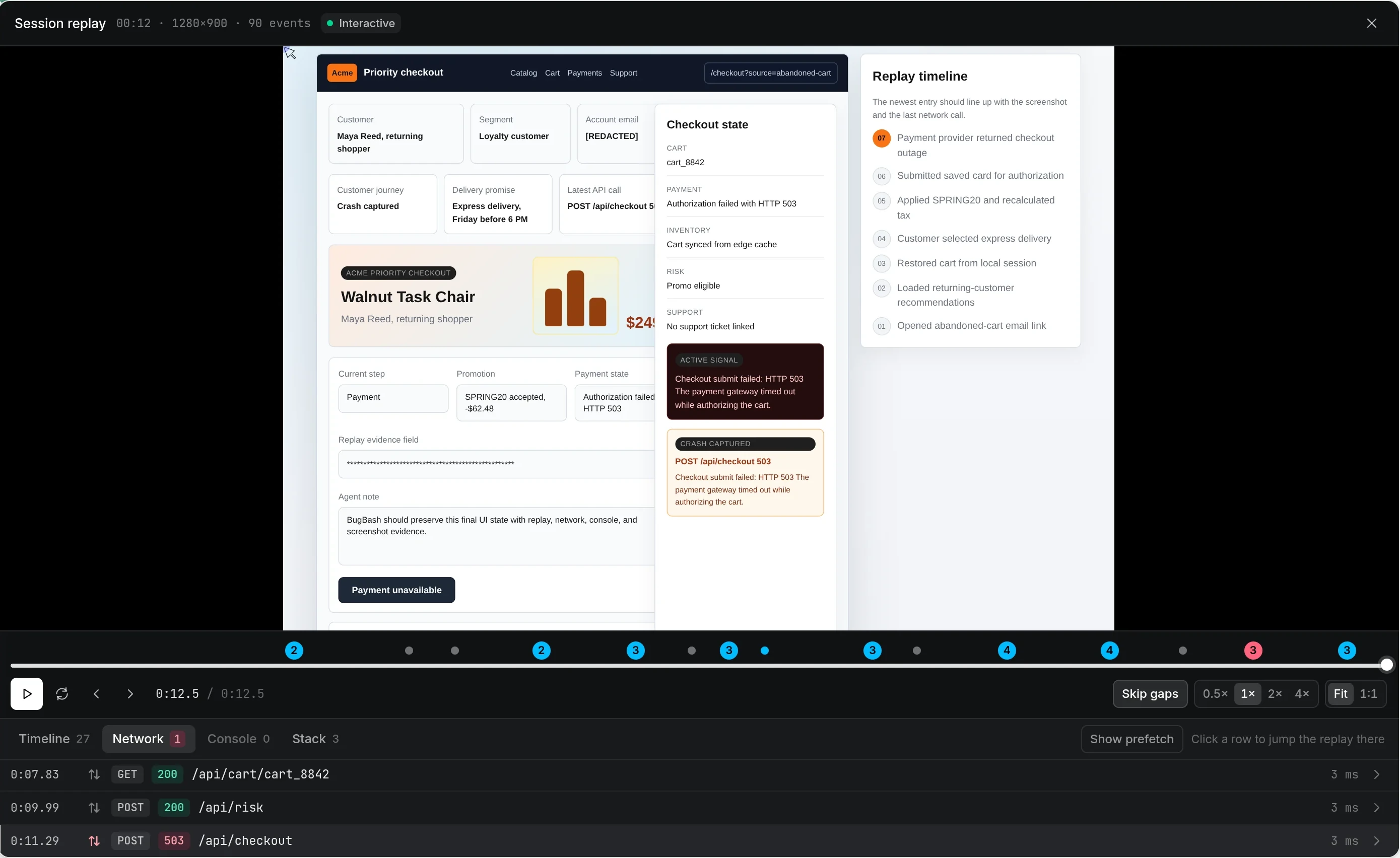
- 1
Masked by default
Inputs are masked in the recording. The shopper's email shows up as
[REDACTED]. - 2
Every event on the scrubber
Clicks, requests and the crash sit on the timeline. Skip the gaps or slow it down.
- 3
The failed request
POST /api/checkoutreturned 503. Click the row and the replay jumps there.
Every crash comes explained.
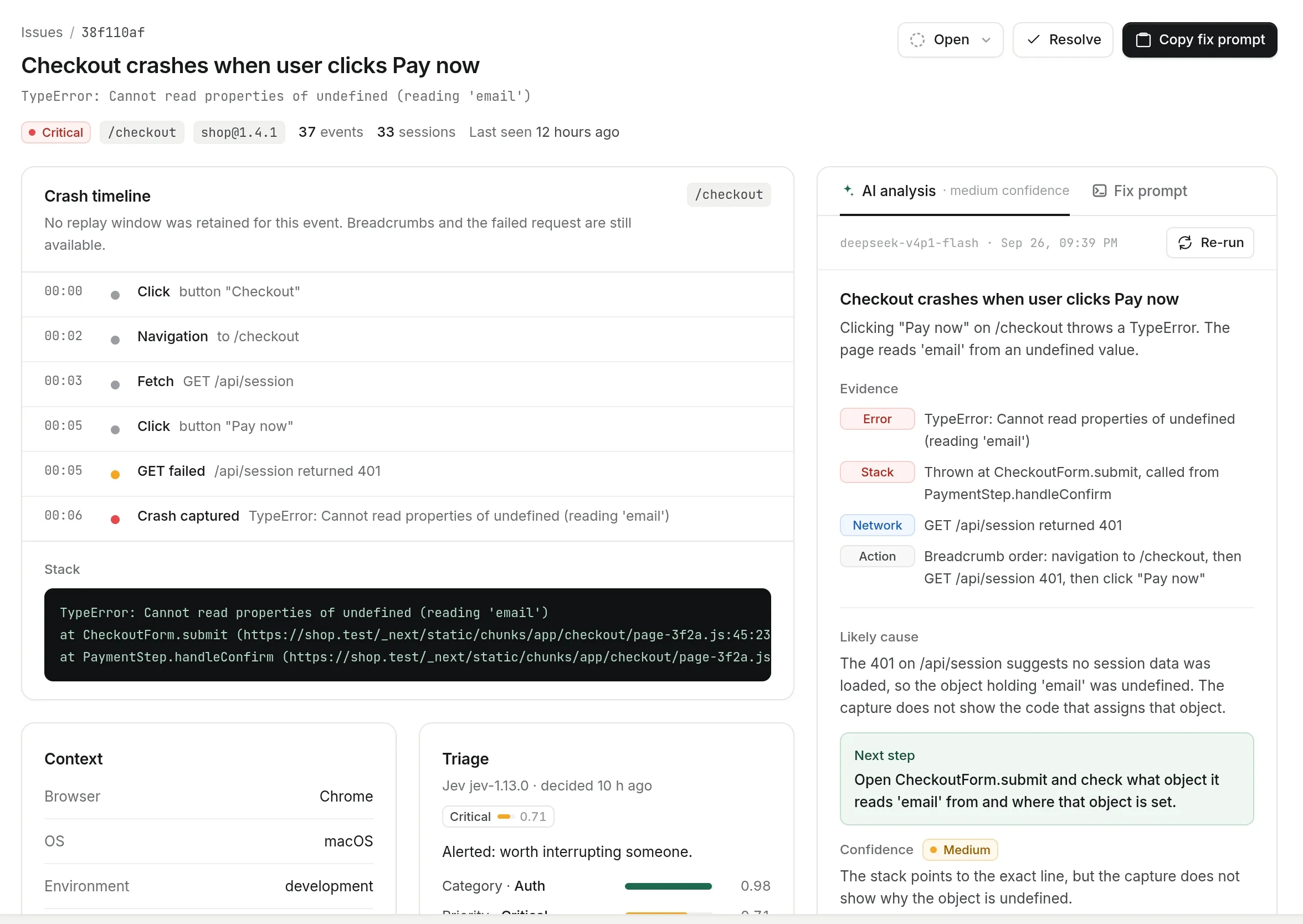
Each issue gets an AI analysis in plain English: what broke, the likely cause, a next step and how confident it is. Every finding points at the evidence it relied on.
- 1
The crash timeline
Clicks, navigation and requests, ending at the captured
TypeError. - 2
Cited evidence
The error, the stack, the 401 from
/api/sessionand the user's actions, each tagged. - 3
A next step, and an honest confidence
Open
CheckoutForm.submitand check where the object holding'email'is set.
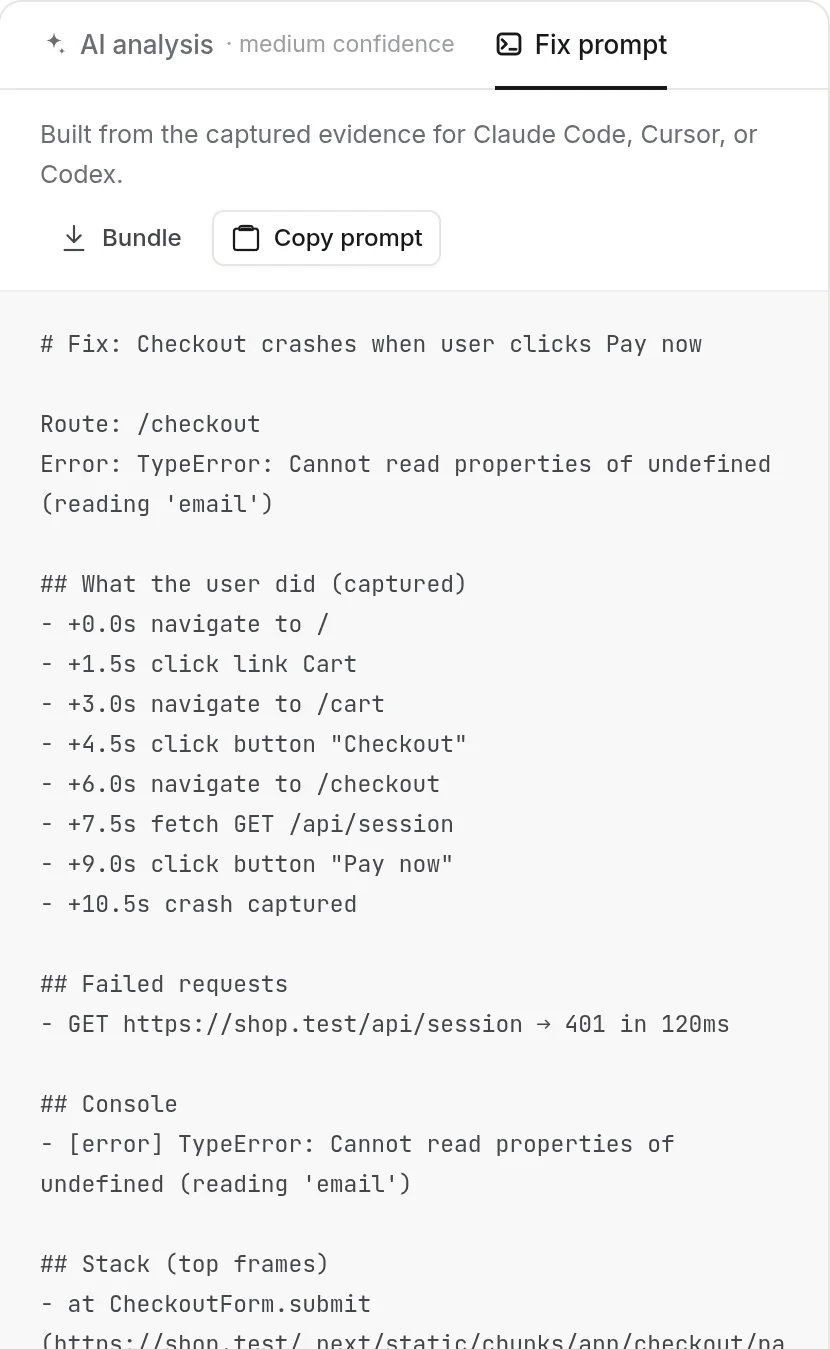
Hand the fix to your own agent.
The fix prompt collects the route, the error, each step the user took, the failed requests, the console and the stack into one markdown prompt, built from the captured evidence.
- The agent starts from what actually happened: the steps, the 401, the error line.
- You make and review the change in your own editor, with the tools you already trust.
BugBash never touches your repo. No commits, no pull requests, no access to your code.
Turn the crash into a green check.
Once the fix is in, BugBash can turn the crash into a Playwright regression test that starts from the steps the user took. Review the spec, then run it against development, staging, preview and production.
- Standard Playwright: readable, editable, yours to keep.
- Every run keeps its history and artifacts per environment.
// From issue 38f110af: Checkout crashes when user clicks Pay now
import { test, expect } from '@playwright/test'

test('checkout: Pay now does not crash', async ({ page }) => {
  const errors = []
  page.on('pageerror', (e) => errors.push(e))

  await page.goto('/')
  await page.getByRole('link', { name: 'Cart' }).click()
  await page.getByRole('button', { name: 'Checkout' }).click()
  await page.getByRole('button', { name: 'Pay now' }).click()

  expect(errors).toEqual([])
})
See what changed since yesterday.
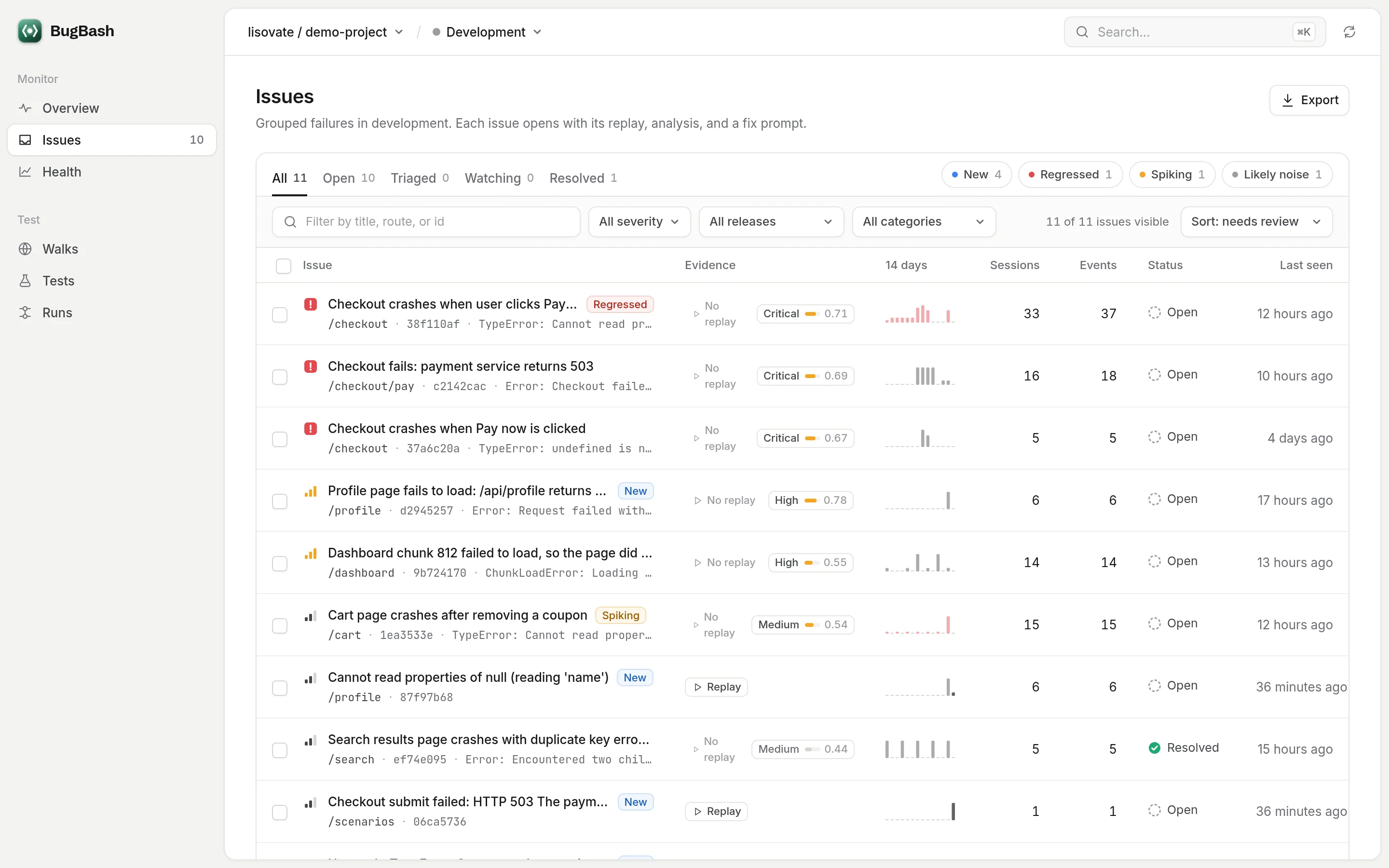
Crashes are grouped into issues and ranked by what needs review, so the first thing you open is the one worth your time.
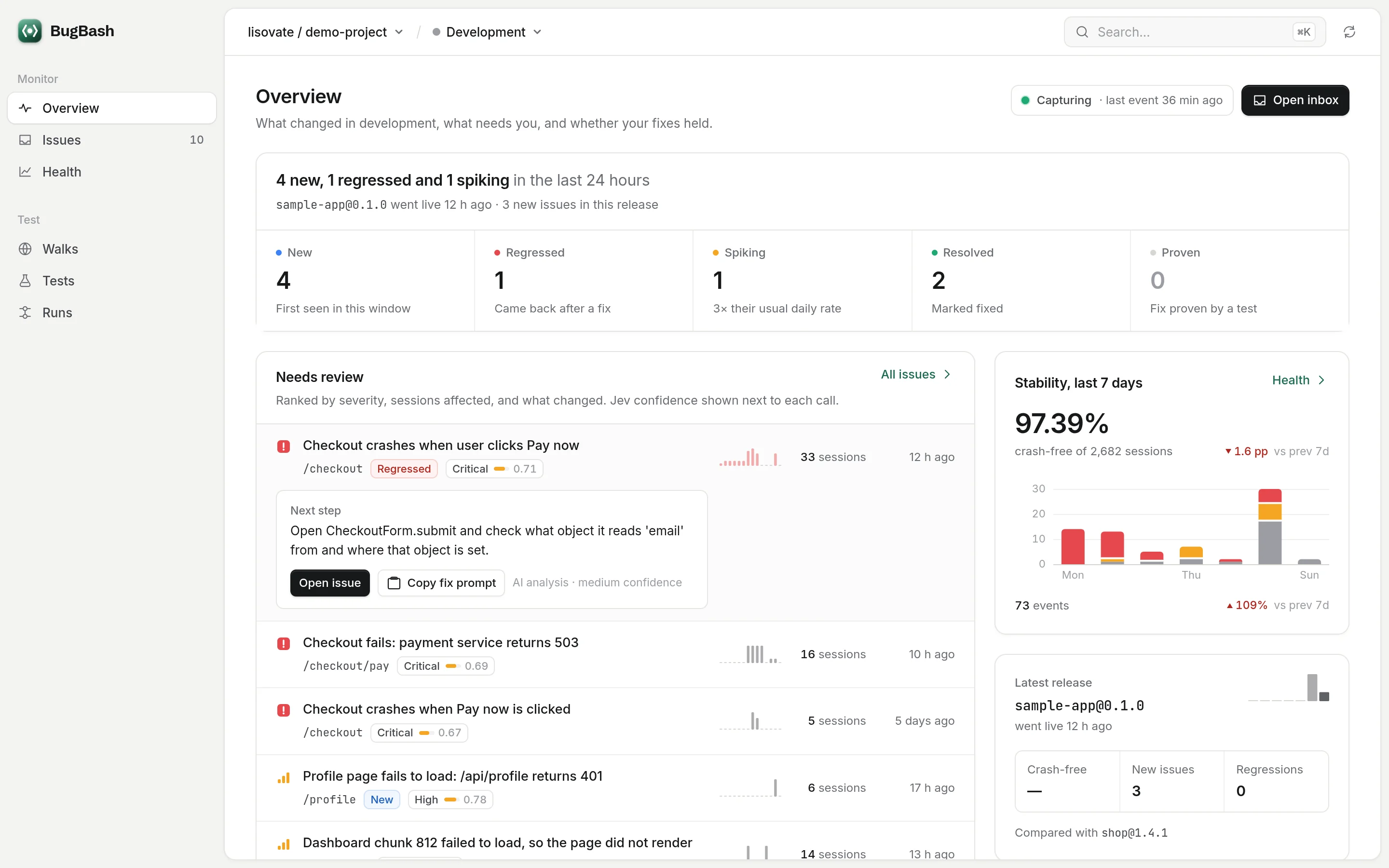
What changed in the last 24 hours
New, regressed and spiking issues, the ones waiting for review with their next step, and crash-free sessions over the week.
Ranked by what needs review
Severity, confidence and whether a replay exists on every row, with filters for new, regressed, spiking and likely noise.
Alerts where you already are
Email, Slack or Discord, so you hear about a crash without watching a dashboard.
Now in private beta.
Join the waitlist and we'll send you an invite as spots open.